
🧭 Introduction
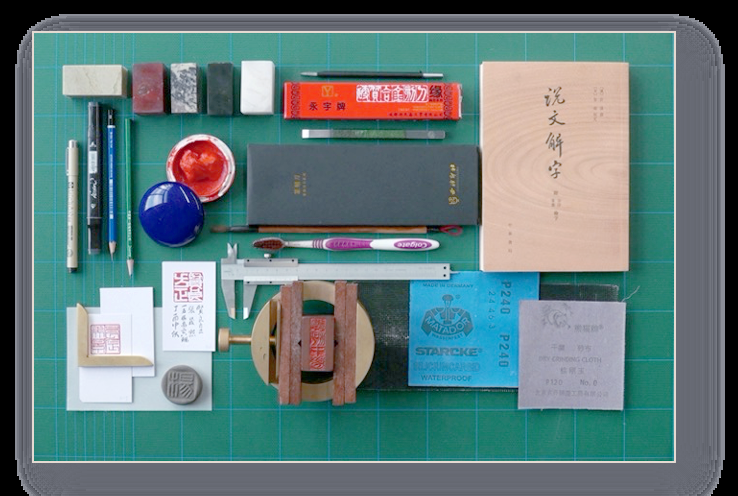
In the timeless art of Chinese seal carving (zhuànkè 篆刻), every mark made with a blade carries thousands of years of history. It is a craft where stone meets spirit, and each carving reflects the artist’s inner world. As the ancient saying goes, “To do a good job, one must first sharpen one’s tools.” Before beginning your seal carving journey, understanding the essential tools and materials is the first and most important step.
(Image suggestion: A serene workspace with carving knives, stones, and red ink paste neatly arranged on a wooden table.)
① The Carving Knife — The Soul of Seal Art
The carving knife is the most vital tool in the art of seal engraving. Its precision determines the rhythm and flow of every carved stroke.
Types of Material:
-
Tungsten Steel Knives – Extremely sharp and precise, ideal for fine lines but slightly brittle if used with too much force.
-
White Steel Knives – Softer yet durable, perfect for beginners due to their flexibility and ease of resharpening.
Blade Shapes:
-
Flat-edge blades for broad, even cuts.
-
Slanted-edge blades for curves, delicate strokes, and detailed character forms.
Carving knives come in multiple sizes, typically ranging from 2mm to 10mm, each suited for different seal sizes and scripts.
(Image suggestion: Close-up photo of various seal carving knives displayed on silk cloth.)
② The Carving Bed and Red Ink Paste
A steady hand needs a steady base. The carving bed secures the seal stone, allowing the artist to work smoothly and safely. Traditional beds are made of wood or metal, combining stability with adjustability.
Meanwhile, red ink paste (印泥) is the lifeblood of the seal. A good paste brings out the richness of the carved characters with deep, saturated color.
Common Types:
-
Cinnabar Paste (朱砂印泥) – Deep vermilion with a classic, elegant tone.
-
Orange-red Paste (朱磦印泥) – Brighter and livelier, ideal for modern use.
-
Antique Brown, Black, or Blue Pastes – Popular among collectors and artists for special artistic effects.
(Image suggestion: A stone seal freshly dipped in cinnabar paste, leaving a crisp red imprint on white paper.)
③ Supporting Tools — Precision in Every Detail
Alongside knives and ink, several other tools support the carving process.
-
Seal Cleaning Brush: Keeps dust and chips away during engraving.
-
Carving Pick (印筋): Used to extract and mix ink paste hygienically.
-
Calligraphy Set: Ink, brush, and paper are used to sketch the seal design before carving.
For sketches, artists often use semi-sized Xuan paper, which absorbs ink beautifully while maintaining line clarity.
(Image suggestion: A craftsman sketching characters with a calligraphy brush beside an unfinished seal.)
④ The Beauty of Seal Stones
Seal stones are the canvas of this ancient craft. Among the most renowned are the “Four Famous Stones” of China:
-
🪶 Qingtian Stone (青田石) – Delicate, soft, and translucent, perfect for beginners.
-
🌕 Shoushan Stone (寿山石) – Smooth and radiant, often used by masters for intricate designs.
-
🔶 Changhua Stone (昌化石) – Noted for its rich oily luster and vivid coloration.
-
🔴 Balin Stone (巴林石) – Firm yet easy to carve, a modern favorite among students and collectors.
Each stone has its own “personality.” The right stone brings harmony between the carver’s intent and the material’s nature.
(Image suggestion: Display of the Four Famous Stones labeled with their Chinese names.)
⑤ Learning and Inspiration
The path of seal carving is both technical and philosophical. Studying classical seal works, such as the masterpieces of Wu Changshuo, helps new learners grasp composition, rhythm, and the essence of seal art.
For beginners, combining traditional study with hands-on practice brings both precision and soul to the craft — where each stroke becomes a bridge between past and present.
(Image suggestion: An open book of ancient seal imprints beside modern carving tools.)
✨ Conclusion
Seal carving is more than an art form — it’s a dialogue between mind, hand, and stone. With patience, the right tools, and an appreciation for tradition, anyone can carve their own mark of eternity within a single square inch.
Explore the art of traditional Chinese seal carving with STAMPISHOP — where heritage meets craftsmanship.